![[LOGO]-Ulixe_Nova-positive](https://www.ulixenova.com/wp-content/uploads/2025/01/LOGO-Ulixe_Nova-positivo.png#25)
10/07/2024
The Smartphone: A Tale from A to Z
15/12/2023
Explore the extraordinary evolution of smartphones, starting with the groundbreaking IBM Simon Personal Communicator in 1992 to the most modern devices. Discover how this technology has radically transformed our society, replacing everyday objects and redefining the concept of communication.
Index
- Evolution of the smartphone: what exactly is it and how has it changed?
- The smartphone today
- Smartphones: the pocket revolution
- A smartphone-proof world
- The gigantic world of mobile gaming
- The Social Networks mobilie
- The future of the smartphone
To date, the smartphone has a huge impact in everyone's lives. Over the years it has taken on an increasing role, for example in terms of services offered and hours of use.
Let's take a dive into the past and analyze the present situation, going over the evolution of the features and services offered by the smartphone. We will then try to imagine the future of these devices, which have changed our society forever.
Evolution of the smartphone: what exactly is it and how has it changed?
First, to navigate the history of the smartphone together, let's start from the beginning. That is, from a common definition of smartphone:
a smartphone is defined as an electronic device that combines the functions of a cell phone and a handheld computer due to the presence of a complete, self-contained operating system.
It was back in 1992, IBM made the first model incorporating such features: the Simon Personal Communicator, featuring a touch screen and the presence of a stylus.
The IBM Simon Phone gave the ability to send emails and faxes;in fact, thanks to a SIM card it was possible to connect to the Internet. This device came with some preinstalled applications, including clock, calendar, calculator and one of the first "video games" of the smartphone era: Scramble. A 4X4 grid with numbers from 1 to 15 and a free space that allowed you to move them around to put them in ascending order.
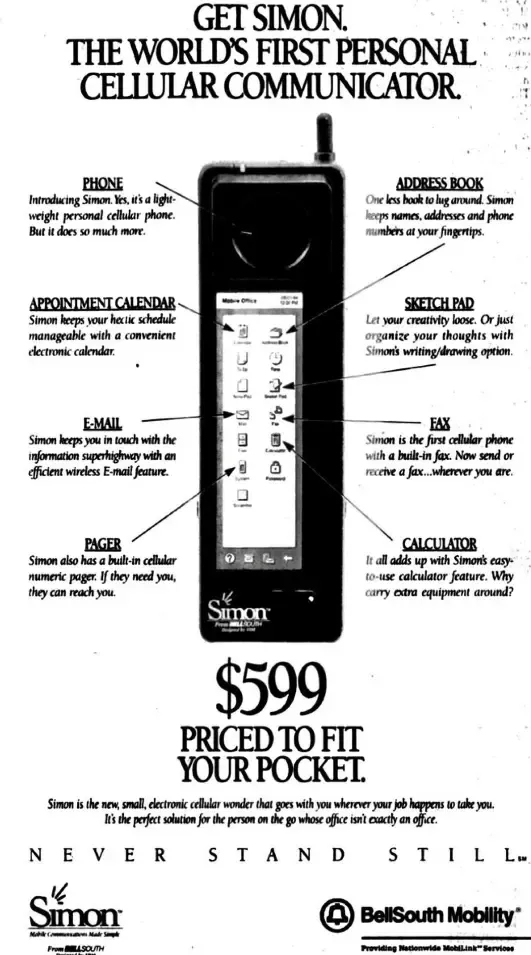
IBM Simon Personal Communicator
Source : Thaddeus
However, the first device to use the term smartphone in advertising was the'Ericsson GS 88, which was announced in 1997 but never commercialized. This device had two processors and only one operating system that ran both. One of the reasons why it was not commercialized was precisely this hardware complexity and the resulting software complexity.
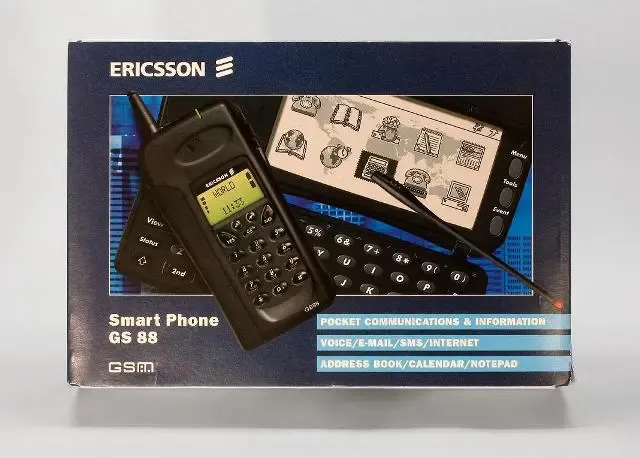
Ericsson GS 88, the first to call itself a smartphone
Source : Ericssoners
In the 2000s, there was a significant spread of a number of BlackBerry signature smartphone models, which featured a physical qwerty keyboard and were appreciated in the corporate environment for their security features and instant, mobile communication.
January 9 , 2007 is a key date in the evolution of smartphones, Steve Jobs announced the first iPhone, do you remember it? Thus began a phenomenon destined to go global that completely revolutionized the mobile device market. S. Jobs said:
"Today, Apple is going to reinvent the phone."
A prophetic sentence, which in hindsight we can only agree with.
In fact, we continue to follow the evolution of this mobile technology: explore the new frontiers of Swift, SwiftUI and UX, too, read Pierpaolo's articleon the latest Swift Heroes event!
In fine, the first device with Android OS, on the other hand, dates back to 2008: the Htc G1 featured both a touchscreen and a slide-out qwerty keyboard.
In addition to the models mentioned above, many others have followed with constant hardware and software improvements. Over the years, the vast majority of models have come to resemble each other more and more, converging toward an idea of a smartphone that is now firmly established among consumers.
Online services: the world at your smartphone's fingertips
In parallel with hardware and software improvements, the world of smartphone services has evolved.
One of several reasons for the success of the IOS and Android systems have been their downloadable app stores, which have been enriched by millions of apps over the years.
The potential of these devices has been sensed by many companies and developers who have created their applications and websites targeting the mobile market and using a mobile first approach.
Ulixe, founded in 2001 by our two founders, has established itself as a pioneer company in app development. Among its successes are. Lumyer Effects, recognized as one of the best trending apps in 2016 by Google, or the most recent creation, Gaudentius. The latter uses georeferenced data to tell the story of the painter of the same name through the territory. Find out more here!
Web content has had to adapt to the small size of screens. This was a reversal of the trend, which is still ongoing today, from what was happening before the widespread adoption of mobile devices, when the main way to enjoy online content was on a PC screen.
Thus were born applications such as Whatsapp (2009), one of the first instant messaging services for mobile that largely replaced SMS, and Instagram (2010), which was one of the first social platforms designed specifically for mobile devices and for sharing photos.
The smartphone today
Today, the smartphone is a mature technology that deeply permeates society. Ubiquitous communication and interconnectedness are now an integral part of everyday life for an important segment of the world's population.
Hundreds of features at your fingertips.
Many daily actions have been simplified, many tools have been incorporated within the smartphone. Today it has become almost taken for granted to have high-resolution cameras at hand thanks to smartphones. Taking photos and videos has become within everyone's reach, we can say viral.
Smartphones have made the sharing of photos, videos and thoughts much more immediate, going on to influence people's identities, social ties and the way companies operate.
Think for example of the spread of photo filters. Although it is only an aesthetic feature, it allows users to create media content expressing their creativity and personality without having to go through video editing and making spontaneous sharing much more immediate. How you can do this with the app Lumyer!
More and more objects replaced by smartphones
Smartphones are increasingly replacing road directories, satellite navigators, compasses, telephone directories, audio recorders, calculators, diaries, calendars, physical payment cards, paper newspapers, notebooks, and sometimes even laptops, at least as far as their more immediate uses are concerned.
Today we are in the midst of the digital transformation, and there are many services and processes, in different industries, that are converging to this way of delivering their offerings.
In short, one of the reasons for the success of these devices has been their ability to aggregate many features into a powerful pocket-sized tool that can be used with just one hand.
Smartphones: the pocket revolution
According to the Digital 2023 Report by We Are Social about 68 percent of the world's population uses a mobile device, and daily usage time is estimated at 5 hours. Even more significant is the percentage of Internet users accessing from a mobile device, at 92.3%. This percentage is higher in developing countries. One reason may be that smartphones are cheaper than other types of devices.
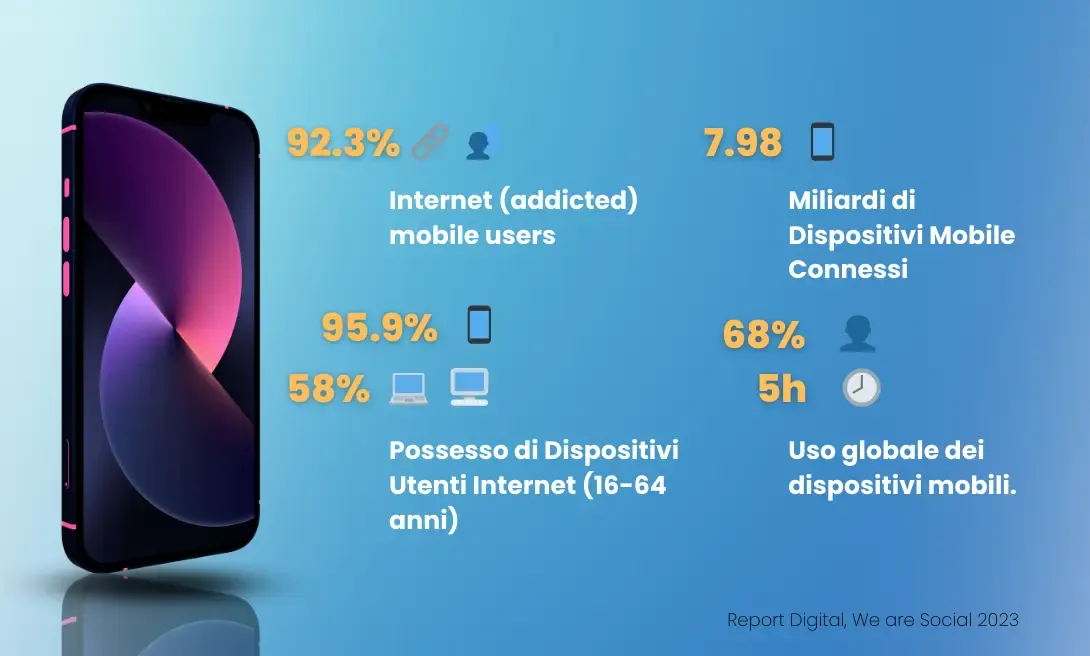
In terms of device ownership, the percentage of Internet users between the ages of 16 and 64 who own a smartphone is 95.9 percent, while it drops to 58 percent in terms of owning a PC, laptop or fixed. This figure highlights how, in a world without smartphones, a good chunk of users would be excluded from using the Internet on their own device. There are 7.98 billion connected mobile devices in the world, and 59 percent of web pages are viewed on a smartphone.
The Internet and smartphones: a history of mutual technological diffusion
The widespread diffusion of social networks, online messaging applications, streaming services, and mobile games has created new habits of Internet use, often right through the smartphone. The link between the increase in Internet use and the widespread diffusion of devices that allow access at any time is clear.
The average daily time spent on the Internet for users between the ages of 16 and 64 is 6 hours and 37 minutes; in Italy this figure drops to 5 hours and 55 minutes. This figure is very much related to the culture of individual countries, rather than an economic reason. In fact, Italy is one of the countries in the world where on average a gig of internet for a mobile device costs less: only $0.12 out of a world average of $3.12. Worldwide, an average user uses about 15 gigs per month.
Italy has a fairly modest percentage of Internet users relative to the total population(86.1 percent) when compared to that of other European countries such as Switzerland (98.4 percent) Spain (94.9 percent) and Germany (93.1 percent).
However, this figure may be due, at least in part, to our position as the second-highest average age country in the world, exceeding 47 years; typically, older age groups are less accustomed to using technology than digital natives.
Focus on Italy: mobile applications
The focus of the Digital report on Italy shows that 2022 1.64 billion applications were downloaded, with a total expenditure of $1 billion. The calculation is quickly made: an Italian in 2022 on average downloaded about 28 applications and incurred an expenditure of about 17 euros.
The report distinguishes the rankings of most downloaded apps between apps and games. The 4 most used apps by Italians are all from META: Whatsapp, Facebook, Instagram, Messenger. Among the most downloaded instead are TikTok, PosteId, and Shein.
Let us now delve into two of the most widely used categories of applications in the world: those of gaming and Social Networks.
A smartphone-proof world
The expansion of mobile devices has revolutionized gaming and social media. With more than 80% of Internet users gaming on smartphones, mobile gaming is a growing market. Similarly, the number of social users has tripled in the past decade, with Italy at 74.5 percent. Whatsapp and Instagram, initially for mobile devices, lead the preferences. Let's now dive into the gaming and social media trends that are redefining our digital connection.
The gigantic world of mobile gaming
Another market that has expanded as a result of the great popularity of mobile devices is gaming. The gaming world was born before mobile devices and was for a long time tied to fixed hardware such as booths, consoles, and PCs. To date, the situation has changed.
Among Internet users between the ages of 16 and 64, more than eight out of ten play games on one or more types of devices. By far the one most used in this regard is the smartphone.
Worldwide, the most downloaded category of applications is mobile games. It is clear how it can be inferred from this data that the mobile gaming market generates enormous economic revenue worldwide and is set to increase further.
Mobile Social Networks
Worldwide the more than 9 out of 10 Internet users use social media. In the last 10 years the number has almost tripled. In Italy, the ratio of population to social media users is 74.5%, although this percentage does not consider users with more than one social profile. Worldwide, about 42.4 percent of mobile device usage time is spent on social and communication applications.
In Italy, the average daily time spent using social media for users between the ages of 16 and 64 is just under two hours, out of a global average of two and a half hours. The main reasons Italians say they use social media are to read news, occupy their free time and keep in touch with family and friends. The social media favorite among Italian users (and globally) is Whatsapp, followed by Instagram, as mentioned earlier, both applications initially intended for mobile devices.
The future of the smartphone
The future of smartphones is the subject of much speculation and interest. Smartphones have been reaching a stage of technological maturity for a few years now.
The road manufacturers are taking is one of improved performance and features, without disrupting consumer habits. It will have to be seen whether and when this technology will be supplanted for a distinct one, or whether smartphones will undergo further transformation without disappearing.
Will the smartphone be replaced?
As written in this interesting article in Wired, most of the subject matter experts who were asked about the future of smartphones think that at least for the next ten years it will continue to be a part of our lives and that it will evolve by integrating new technologies on the crest of the wave such as Artificial Intelligence (AI).
Some experts predict that the following will emerge new categories of devices, such as wearable devices that could offer a more immersive experience than current smartphones.
However, these new devices would, at least initially, be in addition to the smartphone. A concrete example would be smartwatches, among the most popular wearable devices. These not only extend the functionality of smartphones, enabling notifications and remote control, but also introduce new interactions, such as continuous monitoring of health and physical activity.
What if there was an app for everything?
With the exponential increase in available apps, a kind of fragmented digital ecosystem has been created in which smartphones serve as the central platform.
WeChat's model in China, which we might call a single application that encapsulates the main daily functions of the smartphone, could become a worldwide trend by reducing the need to download and manage numerous different applications and accounts.
Artificial intelligence could play a role in this, making interaction with the different features of our devices more immediate. The idea of a single intelligent interface that can handle a wide range of services and features could become the most convenient and widespread model.
However, speaking of WeChat, one cannot fail to mention the problem of user privacy. Indeed, concentrating all user information in one app creates enormous power and value for the company that owns that data, resulting in risks for the users who use the app.
Conclusions
As we have seen the smartphone to date is a key tool for Internet access, instant communication, entertainment and information.
It is therefore safe to expect that it will be part of our lives for several more years. In the near future we can expect software evolutions that will make it even easier to use mobile devices and hardware evolutions that will lower the environmental impact of smartphones, making them more repairable and recyclable.
More efforts are planned to integrate sustainable materials, design more durable devices, and implement cutting-edge recycling practices. Users may be more aware of the environmental impact of their devices and choose products that reflect sustainability values. We have discussed this here!
In conclusion, it will be critical for the future of smartphones to address emerging challenges related to security, privacy, and environmental impact to ensure sustainable and responsible growth of the smartphone industry.