![[LOGO]-Ulixe_Nova-positive](https://www.ulixenova.com/wp-content/uploads/2025/01/LOGO-Ulixe_Nova-positivo.png#25)

10/07/2024
A brief history of Digital Twins: when reality catches up with imagination
17/11/2022
The Digital Twin is an emerging technology that makes it possible to create a digital duplicate of a physical object. In this article, we learn about its history and applications.
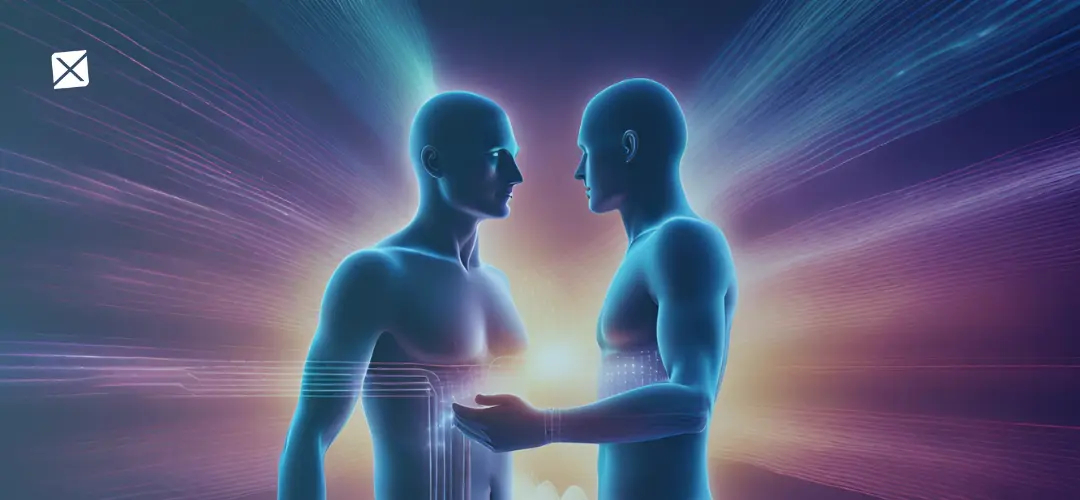
What is the Digital Twin? Simple, who among us, at least once in our lives, has not wished we had a twin? A copy so identical that it presents itself perfectly replaceable to us in situations we don't want or can't support.
Certainly, there is no shortage of literary and filmographic works in which twins exchange their worlds to make up for each other's shortcomings or go so far as to immolate themselves to deal with a condition in no way sustainable by their twin.
What if, rather, we could produce a perfect duplicate of our own person, to be sent "forward" to cope with or simply examine an unfamiliar or difficult circumstance or context?
With such an extraordinary possibility, I believe humanity would make astounding evolutionary leaps! A dream. Yet...
Index
- From dream to idea: the invention of Digital Twins
- To what is the success of the digital twin due?
- Is the game worth the candle?
From dream to idea: the invention of Digital Twins
The question what is the Digital Twin is answered by a certain Dr. Micheal Grieves who, in 2003, during a conference on "Product Life Cycle Management." presented the idea, albeit embryonic, that an artifact (or its management) could be replaced, in its entirety, by a Digital Twin, on a 1:1 scale.
The digital twin was thought of as a perfect representation, apt to reproduce, simulate, predict. The key to it all? Three elements: real space, virtual space and the interconnections that allow the first two to exchange information with a continuous flow of data.
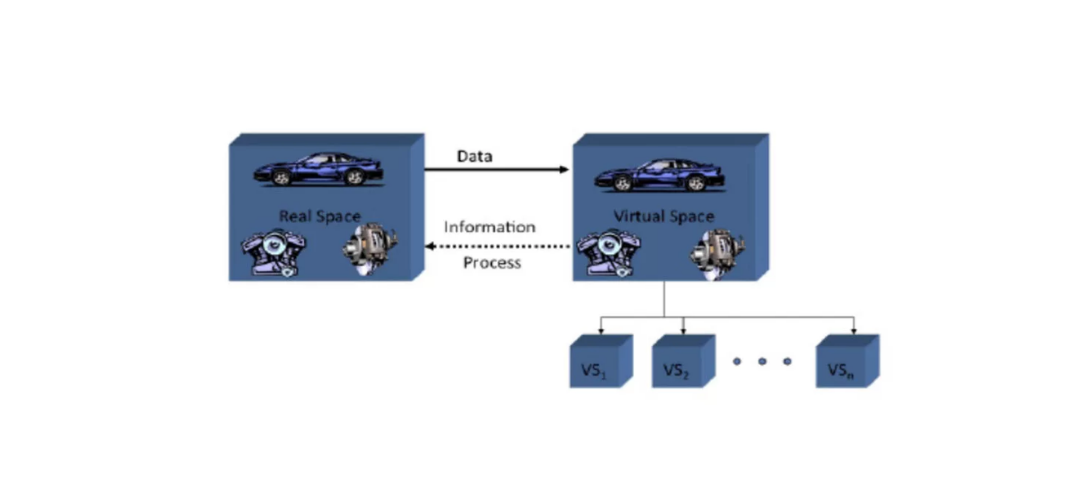
Process and elements of the digital twin
Source: M., Grieves (2001)
From words, to action as the Digital Twin is born
Although the idea of what a Digital Twin is and what it can be used for was already mature, at the time of the Grieves conference, the resources needed for it to materialize into an actually feasible and usable tool were not yet mature; an "incubation" period was needed, lasting a full 8 years, during which an incredible and rapid development of information and communications technologies took place: the emergence of the Internet of Things, improvement of sensors, miniaturization of electronic components, development of Big Dataanalytics...
An ideal starting point for the rise of a concept that, until then, had undoubtedly been undervalued or regarded as pure utopia.
As is often the case, it was aerospace research that, in 2011, first grasped the real potential of having virtual duplicates. Since that moment, the Digital Twin has entered a phase of "development": scientific research has, in fact, begun to take it seriously into consideration, making it the subject of studies, proposing it for various applications and as an alternative solution to "classical" methods, until it has become a tool that can actually be used (and used) in various fields, including those other than aerospace.
To get an idea of how far this tool has evolved, just consider that, in 2018, Gartner ranked the Digital Twin one of the ten most promising technology trends of the next decade.
To make a long story short: virtual twins are among us and are already a current reality. Various industries have already implemented this tool, from Automotive to IT companies.
To what is the success of the digital twin due?
he Digital Twin, as a true digital duplicate of an object, by exploiting data acquired in real time, offers the possibility of predicting its future performance and improving its operation, continuously adapting to multiple situations.
Over time, the idea was further developed with a far more detailed and comprehensive definition, in which there are, not three, but five elements closely related to each other, all equally important for the purpose of representation:
- the physical part-the foundation on which to erect the virtual part;
- the virtual part-an element to support simulation, decision-making and control of the physical part;
- data-the heart of the Digital Twin, a primary requirement for creating new knowledge;
- IT service platforms-key facilities for improving convenience, reliability, and efficiency;
- connections-what allows all the elements to interact and relate to each other.
It is evident how ultra-high-fidelity simulation software and Internet networks form the backbone of the Digital Twin. Sensors, advanced measurement technologies, simulation and modeling techniques, Industrial Internet of Things (IIoT), artificial intelligence (AI) and machine learning are some of the elements that define the universe that sets this incredible world in motion.
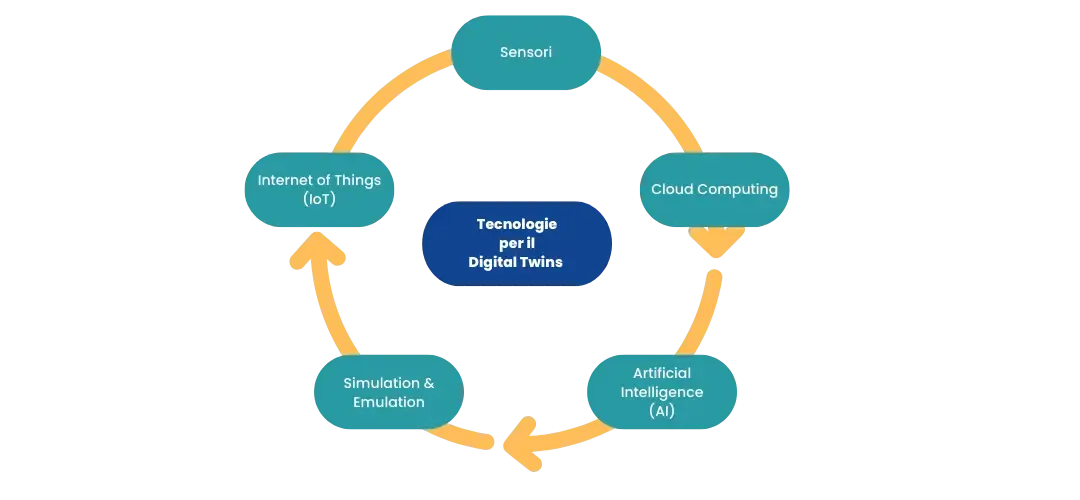
The technologies involved in the process of creating digital twins
The steps that have been taken in these twenty years are nothing short of incredible, although there are many challenges ahead:
- the continuous exchange of information results in the need for adequate connection resources;
- the sheer volume of quantities to be recorded and stored results in voluminous databases and massive storage media;
- software needs to be better optimized, to give the possibility of simple configurations that are better representative of the physical world.
Is the game worth the candle?
Thinking about the roles the Digital Twin can play, it is easy to imagine the countless benefits:
- Monitoring of physical anomalies resulting from factory defects or subsequent failures of the actual counterpart;
- predictions about the residual reliability of the associated physical system;
- Optimization of the design phase;
- life cycle optimization.
The consequences would be considerable:
- Reduction in design costs and Maintenance, Repair and Overhaul costs;
- Increased operational availability of physical resources;
- Increased performance and reliability.
In short: a window to a vast world full of possibilities was opened in 2003; subsequent technological and IT developments have laid a path that, though still long and winding, already has a solid foundation. Current and forthcoming research and energy invested in this area will lead us to a future era that is more efficient, economical and, not least, environmentally friendly.