![[LOGO]-Ulixe_Nova-positive](https://www.ulixenova.com/wp-content/uploads/2025/01/LOGO-Ulixe_Nova-positivo.png#25)


10/07/2024
Finger Reader: reading with your finger is possible
02/12/2022
Finger Reader is a digital ring that uses OCR technology to read text aloud. This device is an important innovation for blind people, who can thus access information and content of all kinds.

Reading with your finger is possible thanks to the Finger Reader, the digital ring that helps presons who do not have the ability to read, even if they want to. Blind people for example have this problem! And who would have thought?
In 2015, to make it easier for blind people to read, MIT and the National University of Singapore jointly developed a digital product capable of "reading" using the finger: the Finger Reader. This enables people with visual impairments to read, but also those with learning disabilities or those who simply haven't learned yet!
Reading with your finger is simple, this wearable device connects a bracelet to a ring with a built-in camera, leaving your hands clutter-free. But let's see how it works and what technologies make it possible.
Index
How the Finger Reader works
It only takes a few moves to read with the Finger Reader: you put on the ring, press the power button, and run your finger over what is to be read. At this point the magic begins: the little camera on the digital ring will read aloud the indicated wording.
Now, you might ask, "How can a blind person understand when the line ends?" Here comes the innovative part: the camera processes the reading space, the word indicated and the next words.
When you get to the margin, it notices that the user is going beyond the writing, it will vibrate slightly to signal that you need to go over. Similarly, the Finger Reader will understand if you are skipping a line or not continuing correctly.
Let's look in detail: technology and inclusion
Let's start with the hardware part. The ring initially consisted of four vibrator motors but, after a series of tests, they were down to two. These motors are responsible for giving signals, such as end-of-line, to the user. Two, rather than four, motors were chosen as this makes the vibrations easier to sense.
The software part of the Finger Reader is more complicated. To realize it, a software stack was created including:
- A sequential reading algorithm,
- A hardware control driver;
- integration layer with Tesseract OCR;
- a TtS speech synthesis library, the one that reads, to be clear.
Reading Algorithm and the ORC Engine
L'reading algorithm, the real highlight, is composed of several sub-algorithms. The latter, first and foremost, are intended to detect the scene (written), the finger (pointer) and then to handle the read line (absent, present, finished).
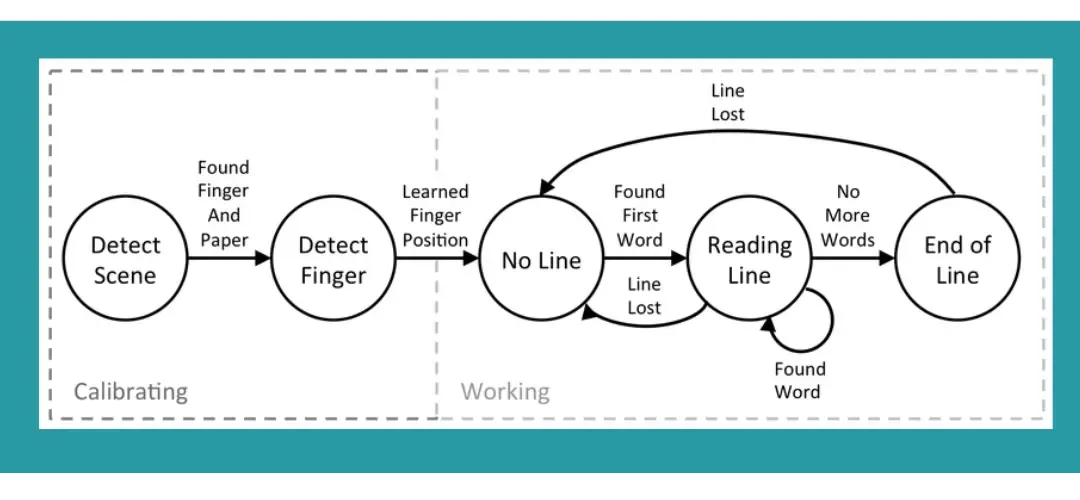
Sequential text reading algorithm
Source: Roy Shilkrot & Co, 2015
The camera, after calibrating itself, learns to tilt, adjust images and focus so that the lettering is "readable" for it. At this point an area is selected, taking the bottom of the letters as a reference point, applying ad hoc rules for those that go below the line (g, j, y, etc.).
The next step is to figure out how to wrap: by calculating letter height, punctuation, and sentence meaning. The ring, thus, understands that there may be a line underneath and then vibrates to tell the user to wrap!
Now it is time for theORC engine, which makes its appearance by correcting finger movements. When the reader is certain that a word is right, he says it out loud. With the confidence that only the Finger Reader can have.
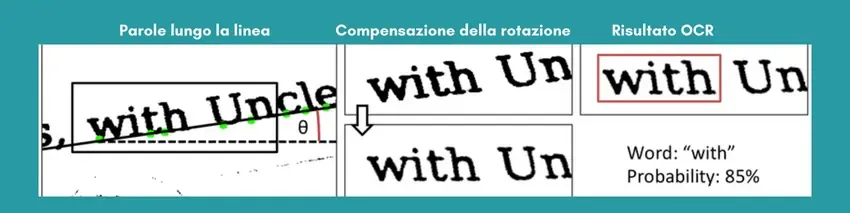
Word identification process
Source: Roy Shilkrot & Co, 2015
Then it's perfect!!!
Unfortunately, no, despite the string of awards won and the sure usefulness, this tool is not yet on the market, as it is not supported by investors.
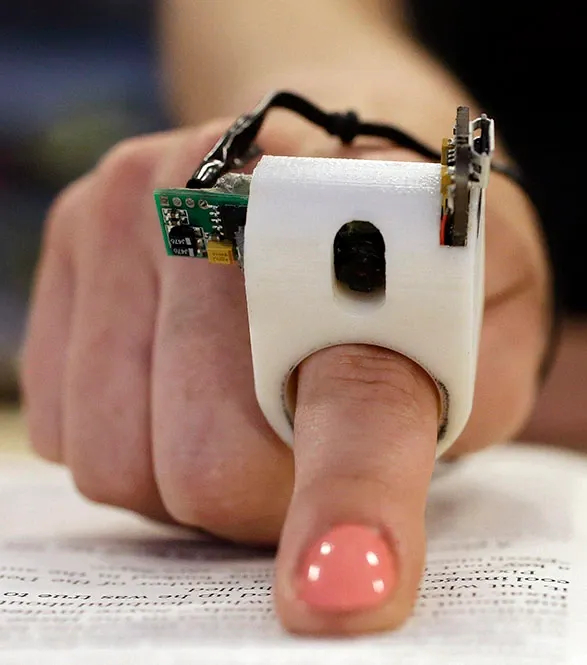
Prototype Finger Reader
To date, the Finger Reader, is still only a starting point for an even better digital product that aims for inclusiveness.
It is often forgotten that making a site or App accessible representsthe breaking down of an architectural barrier. This, is important because the world itself is becoming computerized and must remain accessible.
Thus, it can be said that accessibility, at least in the IT world, is synonymous with inclusiveness.
It is therefore task of the developers aim for technologies that are well designed and easily adaptable according to needs and requirements.
Developing an accessible technology service means, not only going out to meet people with disabilities, putting everyone on an equal footing, always!