![[LOGO]-Ulixe_Nova-positive](https://www.ulixenova.com/wp-content/uploads/2025/01/LOGO-Ulixe_Nova-positivo.png#25)


10/07/2024
Overview of High-Performance Computing and its Applications
27/05/2023
Discover the world of High-Performance Computing (HPC) and its applications in areas such as science, industry, and data analysis.

High-Performance Computing, what is it? Imagine preparing a minestrone with five different vegetables: each vegetable takes time to prepare (say one minute?), and by asking four other people to help, you could finish in one minute; cooking, on the other hand, is a sequential process, i.e., you cannot parallelize...
Similarly, a computer processor handles only one process at a time. However, when it comes to complex tasks such as climate models, data analysis or new drug discovery, thousands of computer processors can work in parallel thanks to High-Performance Computing by handling large-scale computations.
This is the world of supercomputers and high-performance computing that I want to tell you about because HPC has become critical for industries and government organizations, indispensable for scientific research, and very impactful on our daily lives!
Let us look together at what supercomputers are and its applications.
Index
- Applications of HPC: Advanced solutions to complex problems.
- High-Performance Computing technologies and components: Hardware and software for exceptional performance
- Cineca: Italian Excellence in High-Performance Computing
- Challenges and future developments of the supercomputer
- Conclusions
Applications of HPC: Advanced solutions to complex problems.
High-Performance Computing finds use in a wide range of industries and applications: the computing power provided by HPC technologies makes it possible to solve problems that would otherwise be unsolvable, accelerating development time and reducing production costs.
Briefly, some examples of application areas of HPC are:
- sciences:
- Climatology: weather forecast;
- Geology: earthquake prediction;
- Biology and chemistry: development of new drugs;
- physics: study of fluid dynamics flows, discovery of galaxies and particles;
- Industry
- Supply chain: waste reduction;
- Energy: discovery of natural resources, design of materials for energy storage;
- Production: failure prevention;
- Construction: safer and more sustainable structures;
- Cybersecurity: more robust security systems.
- Data analysis:
- Big data and distributed computing: pattern recognition;
- biomedical and environmental sectors: medical image analysis, strategies to limit pollution;
- rendering: creation of high-definition images and videos;
- machine learning and deep learning: large and sophisticated learning models, in all of the above areas!
- HPC
- No, I am not joking. The theories and hardware used by supercomputer take a lot of resources to develop. Why not then use HPC to improve HPC? It is meta-HPC, little known to the uninitiated.
High-Performance Computing technologies and components: Hardware and software for exceptional performance
It is possible to do small experiments in supercomputing even at home, however, to achieve outstanding performance requires supercomputers, based on technologies hardware e software highly specialized.
A Hardware Architecture for High-Performance Computing.
A computing cluster is a group of networked computers working together to perform a computationally intensive task. A supercomputer is a high-performance system with high-speed memory, parallel file systems, powerful processors and accelerators (CPUs, GPUs, TPUs, and others), and does not necessarily consist of a cluster.
Software Components for a Supercomputer
Software components include cluster management software (with control function), compilers, development tools (such as MPI and OpenMP), and, of course, parallel algorithms.
Cineca: Italian Excellence in High-Performance Computing
Cineca, Consorzio Interuniversitario del Nord Est per il Calcolo Automatico, is a nonprofit organization that plays a leading role in High Performance Computing in Italy and Europe. Founded in 1969, Cineca promotes scientific research and technological innovation through the use of advanced computing solutions. Thanks to its close collaboration with academic institutions and companies, Cineca participates in major research and development projects.
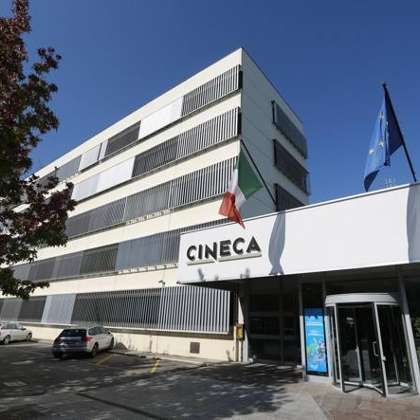
Source: CINECA Office Photos
The challenge: Providing computing power and data management
The main challenge faced by Cineca is to provide significant computing power and reliable infrastructure to meet the crescent demand for computational resources from universities, research centers and businesses. With the increase in the amount of scientific data generated and the need to store it securely, Cineca has also had to think about how to manage it efficiently, ensuring its accessibility by the scientific community.
The solution: investment in infrastructure and IT partnerships
Cineca has made substantial investments in a state-of-the-artcomputing infrastructure, including high-performance computing clusters, world-class supercomputers, and a high-speed interconnect. It has also partnered with major technology providers(Intel and Lenovo), to integrate specialized accelerators and further increase computing power.
A significant achievement is the implementation of Leonardo, one of the most powerful and advanced supercomputers in the world and the second in Europe.
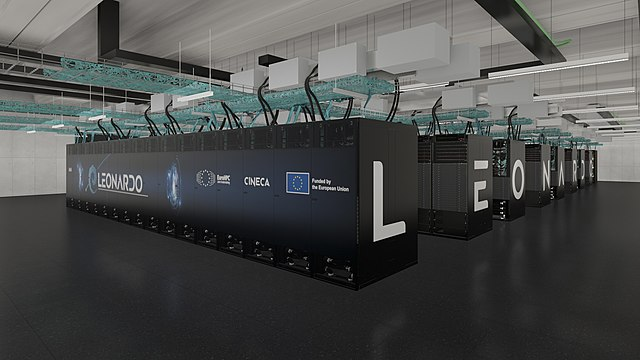
High-Performance Computing Leonardo
As for software, Cineca has developed parallel programming libraries and frameworks: IDEs, data analysis tools, and cluster management software. Below is the structure of the supercomputer developed for Leonardo.
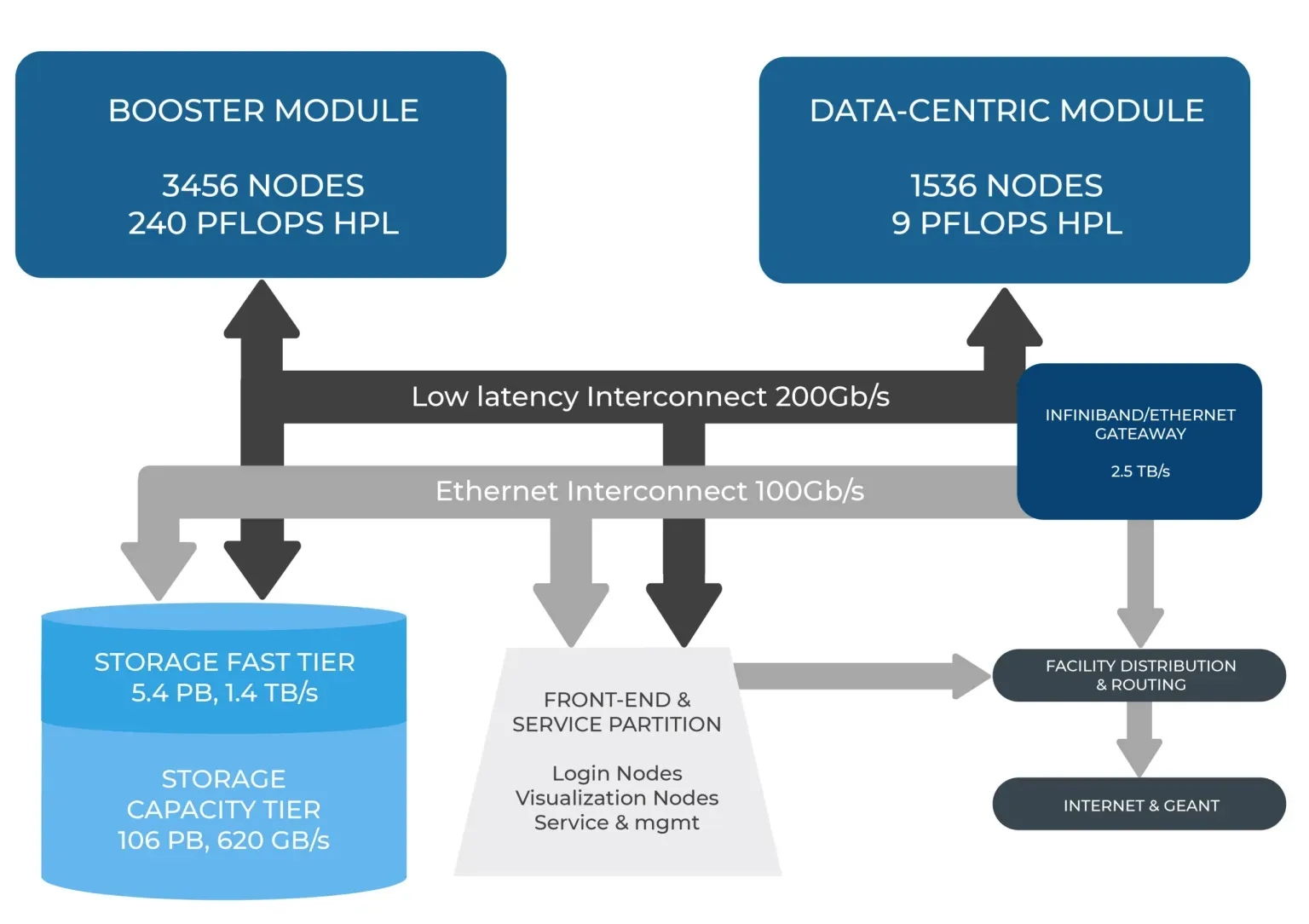
Overview of Leonardo's supercomputer architecture (source: Leonardo Pre-exascale Supercomputer)
The results: accelerated research and greater efficiency for companies
Thanks to the infrastructure provided by Cineca, users have been able to tackle problems of increasing size and complexity: researchers have benefited from reduced computing time, speeding up their research; companies have been able to run complex simulations and explore new solutions more efficiently.
Challenges and future developments of the supercomputer
Supercomputing has the potential to solve--quickly and accurately--problems of great social significance; however, its use for these applications requires accountability and transparency, so as not to abuse natural resources.
The use of artificial intelligence in supercomputers
Artificial Intelligence is one of the most promising technologies of our time, and High-Performance Computing can support its development and deployment: more specifically, it can train AI models on large datasets, accelerating learning and increasing accuracy. However, deploying AI on a large scale will require further evolution of HPC technologies to meet growing computational needs.
Convergence High-Performance Computing and Big Data
These are two disciplines that are getting closer and closer. Big Data requires an immense amount of resources, provided of course by HPC, which accelerates data analysis and improves the quality of results. This synergy will hopefully lead to advances in countless fields.
Sustainability and energy efficiency of HPC
Supercomputers require an immense amount of energy! This could become a problem unless an appropriate management strategy is used that requires: more advanced technologies (such as coprocessors), water cooling, or renewable energy to sustain data centers.
Increase in performance of the world's fastest supercomputer per year"
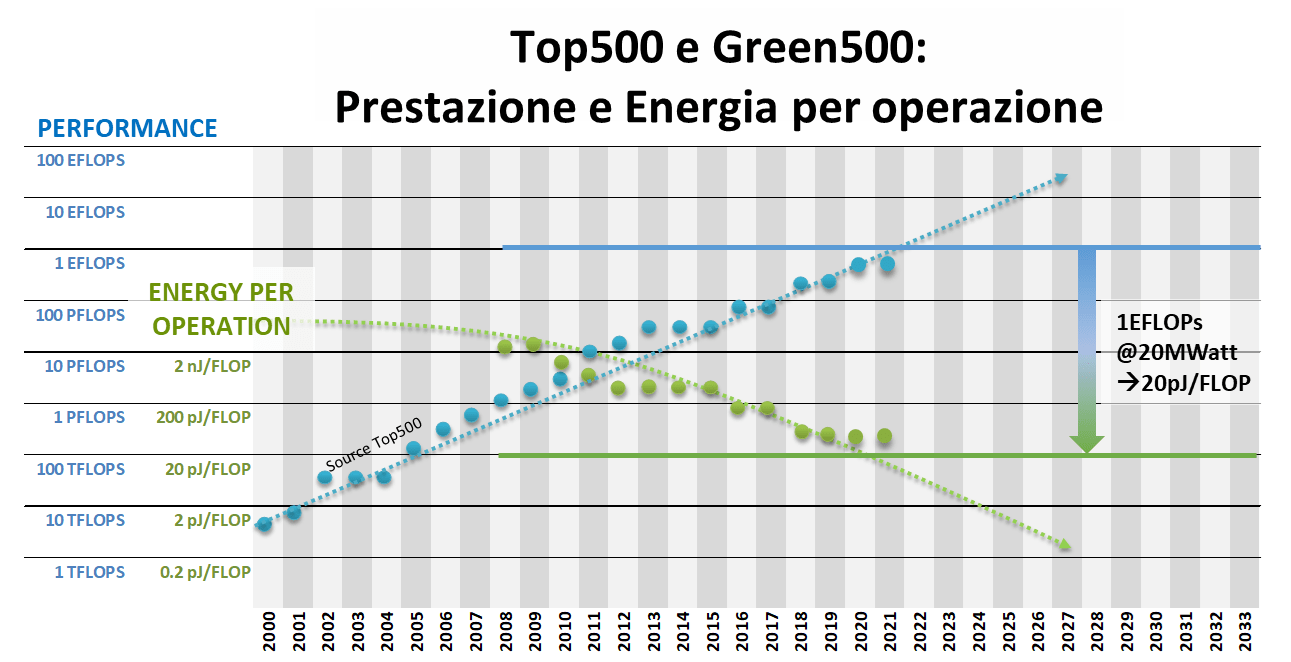
(Source: Green Computing: all the challenges to building energy-efficient supercomputers - Digital Agenda
Conclusions
In summary, High-Performance Computing (HPC) has emerged as an indispensable ally for industry and research, offering tremendous computing power to tackle complex problems efficiently. Despite high implementation costs, HPC continues to spur innovation and be an engine for scientific and technological progress.
However, the true potential of HPC is still being developed. We are seeing an interesting convergence between supercomputing and other cutting-edge technologies, such as artificial intelligence and big data analytics. This synergy opens up new perspectives, accelerating learning and improving the quality of results, and stimulates innovation in multiple areas.
High-Performance Computing will play an increasingly crucial role in shaping the future of society and innovation, but in order for it to be harnessed responsibly and sustainably, it is essential to take a transparent approach, reducing the exploitation of nonrenewable natural resources for energy sustenance.