![[LOGO]-Ulixe_Nova-positive](https://www.ulixenova.com/wp-content/uploads/2025/01/LOGO-Ulixe_Nova-positivo.png#25)


10/07/2024
The future of JavaScript frameworks
03/03/2023
Learn about the future of JavaScript frameworks according to the "State of JavaScript 2022" and the emergence of new alternatives such as Svelte, Solid and Qwik.

Is the future of JavaScript and related technologies uncertain? Without a doubt in web development, Angular is the most sought-after skill, especially in Italy (React follows right behind).
However, the two Front End technologies are starting to be progressively less and less valued by developers according to the "State of JavaScript 2022″ Report.
We are beginning to see a loss of interest not so much from the market, but rather from the developers themselves.
The reasons may be various; let's try to analyze some of them.
Index
- JavaScript: Angular and React are mature frameworks
- The future of JavaScript frameworks
- What about in Italy? what is the future of JavaScript?
- The JavaScript framework market is buzzing more than ever before
JavaScript: Angular and React are mature frameworks
Did we just publish an article about how Angular and React are the most in-demand technologies on the market, and next thing we know we're talking about their decline? No, we haven't gone crazy!
First, to learn more about what Angular and React are I invite you to check out the article by our frontendist Vincenzo.
Let us not waste any more time describing the frameworks, rather let us analyze this phantom "decline" mentioned at the beginning.
Angular was launched in 2016, while the first version of React was in 2017. If you think 6 or 7 years in computer science is a century, in web development it is a geological era.
Angular and React are currently in production on so many websites, including those of big companies. Over the years they have shown their full potential (still huge), but also all their weaknesses.
Huge bundles, slow compilation, quite a lot of code to deploy on servers, seemingly simple learning curve, are just some of the issues with large frameworks.
They give you so many possibilities, but if you don't master them, they risk getting out of hand.
In fact, Microfrontend has been increasingly talked about lately precisely because websites with a framework infrastructure have become huge and complex to manage.
The future of JavaScript frameworks
The State of JavaScript 2022 Reportsummarizes over forty thousand views and opinions of developers from around the world in order to investigate the future of JavaScript.
According to reports, new Front End frameworks such as Solid and Qwik are suggesting that React does not have the answers for everything.
On the server side, Astro, Remix and Next.js are making people reconsider the amount of code they need to send toward the client.
Another framework that was born a few years ago and has now reached a good maturity is Svelte, whose leitmotif is speed, speed, speed(seriously, on their site they repeat it 3 times in a row).

JavaScript Front End Framework
The most significant figure is definitely the interest in Angular, which from 2016 to 2022 suffered a 26% loss of interest, from 68% to 43% of respondents.
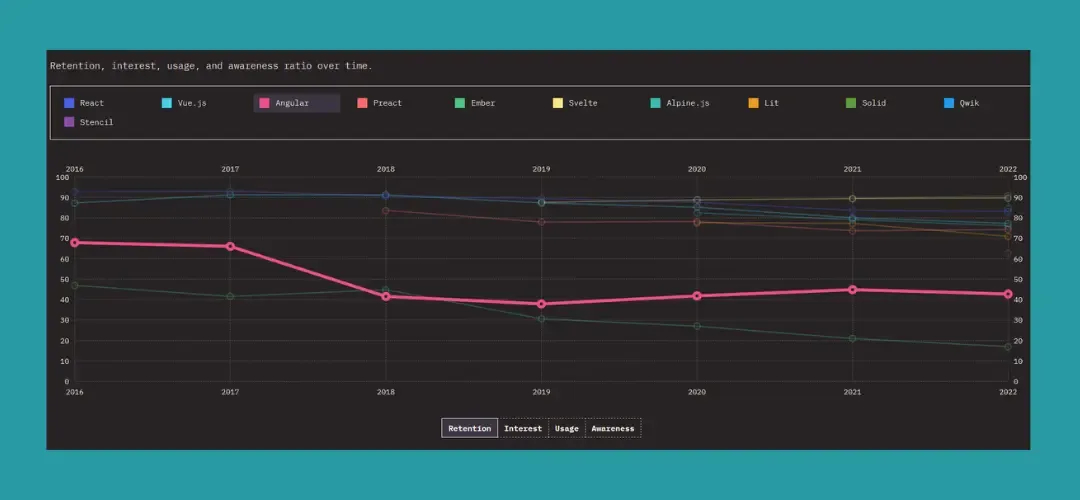
Retention Angular - State of JavaScript 2022
Interest refers to a developer who has used Angular and would like to reuse it in the future. In contrast, the percentage of people who have heard of it and would like to learn it (again from 2016 to present) has gone from 50% to 20%, even worse.
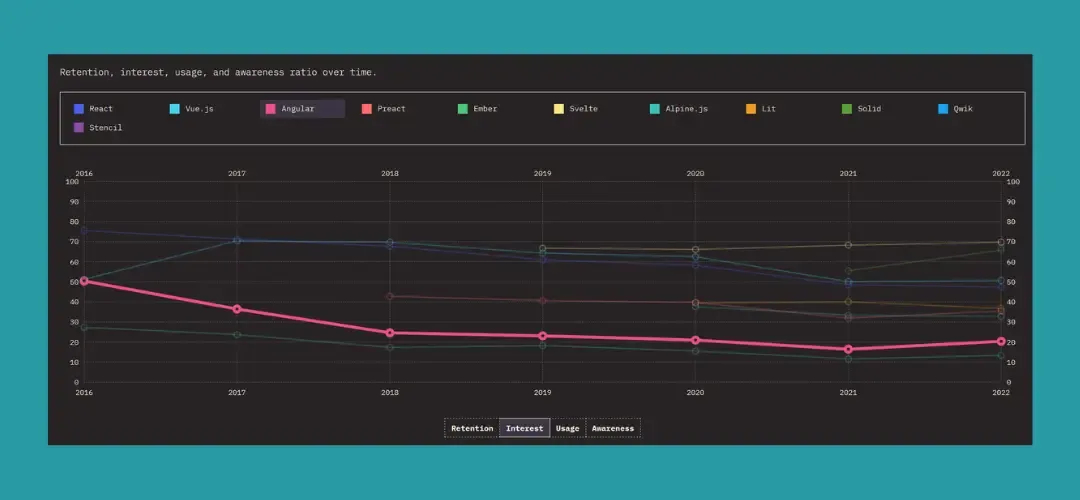
Angular Interest - State of JavaScript 2022
Similar discourse for React, but with generally higher percentages:interest dropped from 92 percent to 83 percent, while the percentage of people who would like to learn it dropped from 75 percent to 47 percent.
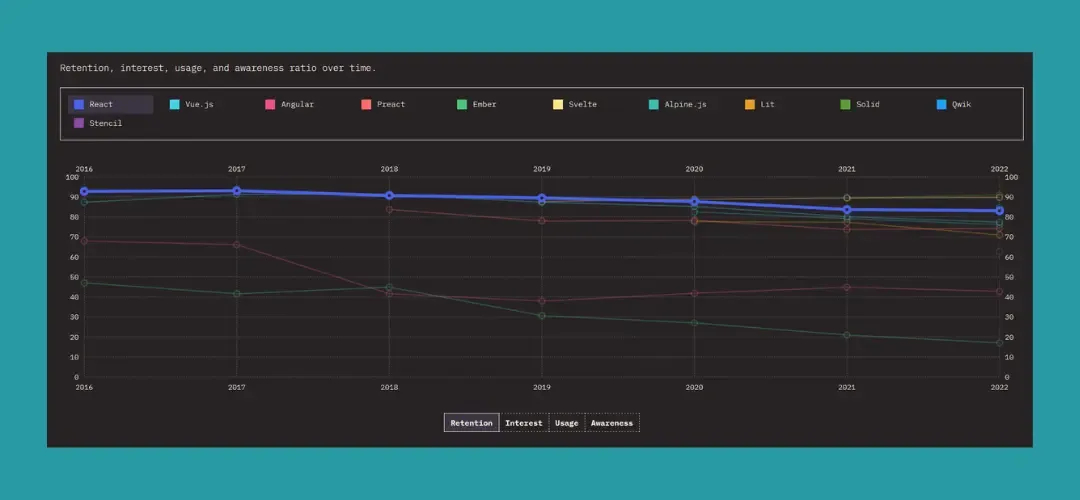
Retention React - State of JavaScript 2022
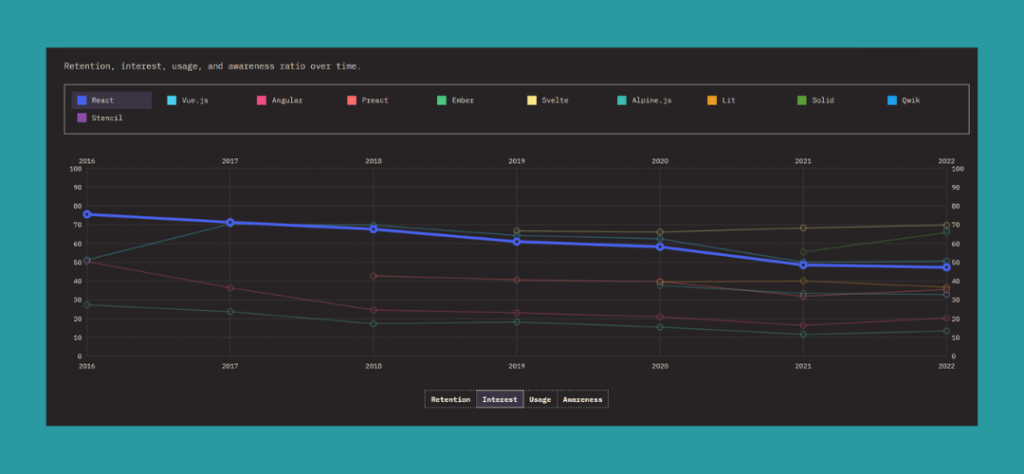
Interest in React - State of JavaScript 2022
Svelte , on the other hand, has seen interest rates rise (albeit slightly) since it was launched(2019), from87 percent to89 percent of people who have used it and would like to reuse it and from 66 percent to 70 percent of people who would like to learn it.
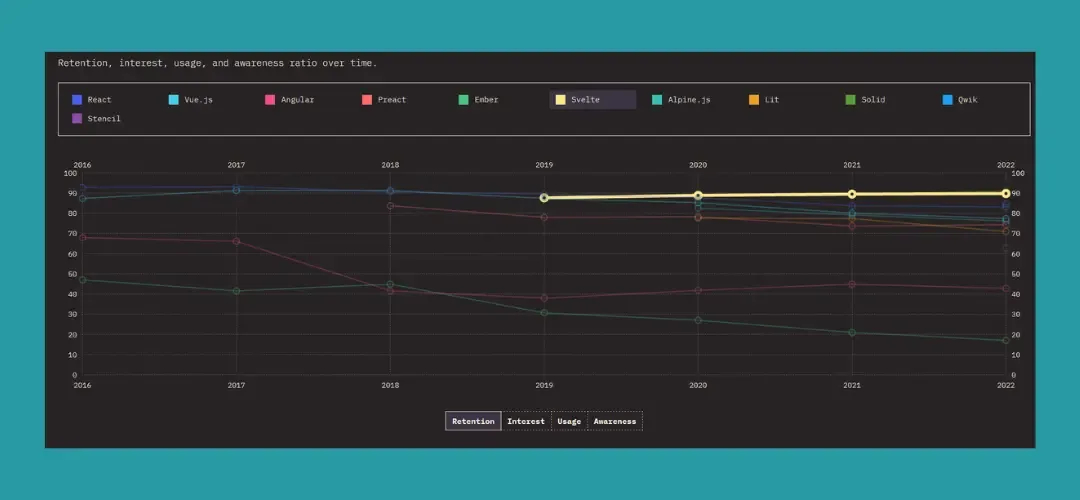
Retention Svelte - State of JavaScript 2022
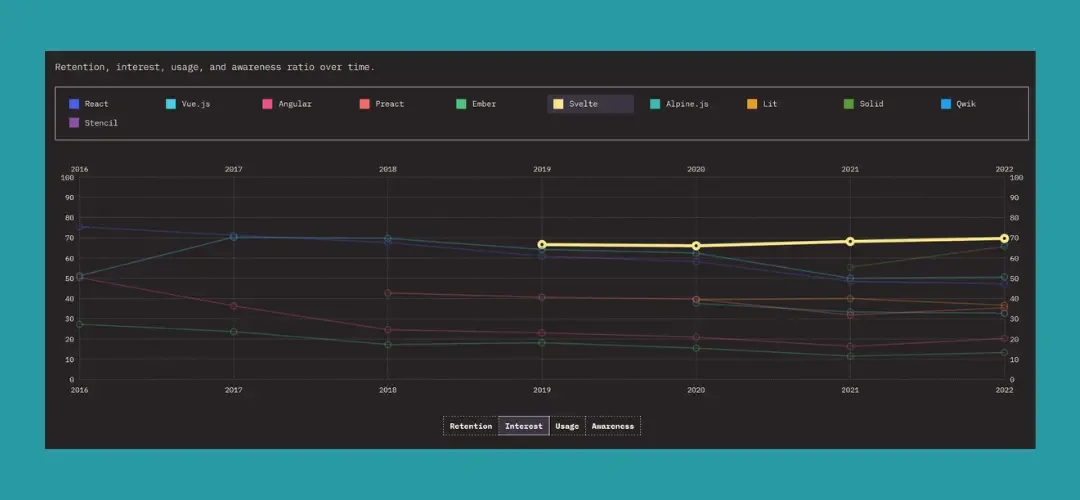
Interest in Svelte - State of JavaScript 2022
The motivations behind these numbers
Of course, one must consider that these data are constructed on a globally significant but also quite heterogeneous sample: different ages and occupational levels.
Certainly there are various motivations for interest in one product over another, such as:
- Ease of use,
- community support,
- But also word of mouth.
Svelte, Solid, and Qwik seem to bring innovative solutions regarding the speed of JavaScript code compilation.
For example, unlike React, these frameworks directly compile components in JavaScript instead of relying on the concept of virtual DOM to update data in the DOM. Angular, on the other hand, does not rely on the virtual DOM, but it has its own change detection mechanism based on Zone.js that is just as fast.
Another factor to consider is the widespread knowledge one has of a framework: the more it is used, the more its limitations are exposed, especially as complexity grows. It may be that over time new products also expose their limitations and are gradually abandoned and move toward others that perform better.
What about in Italy? what is the future of JavaScript?
Unfortunately, the survey data cannot be displayed by respondents' country of origin, but thehe percentage of Italians who participated stands at around1.3% of the total. It is assumed that the situation in our country is no different from the rest of the world, although here the news comes a little late as always.
No doubt the Italian big companies still prefer to rely on established frameworks that offer a lot of support, rather than relying on technologies that are new and on which developers do not have enough experience.
Another important factor is continuity: from 2016 onward many web portals have been completely redone from scratch in Angular or React, so it is to be expected that people would still prefer to continue quite a bit with maintenance on the same technologies rather than do everything from scratch again.
The JavaScript framework market is buzzing more than ever before
In conclusion, whatever framework we talk about, the keywords are always the same: ease of use, fast learning curve and performance. There are no miracle solutions; each framework has its strengths and weaknesses.
If in fact Angular is slightly slower in compiling and detecting changes in the page than Svelte, it has as a strength that it offers out-of-the-box a number of features (routing, Http client, multilingual support, and more) that on other frameworks have to be made up for with third-party solutions.
It is up to us developers to delve deeper into studying these solutions to package the best possible product, regardless of the framework used.
Because even the best of technologies, if misused, can lead to disaster.
Thanks for getting this far and see you next time!