![[LOGO]-Ulixe_Nova-positive](https://www.ulixenova.com/wp-content/uploads/2025/01/LOGO-Ulixe_Nova-positivo.png#25)


10/07/2024
Becoming a programmer: university or academy?
06/09/2023
Find out whether it is better to study computer science in college or take a crash course to become a programmer. Advantages and disadvantages of both choices.

Becoming a programmer, in recent years, is getting "easier" because we are seeing an increasing prevalence of intensive courses, or Academy, that without prerequisites that promise quick and effective training aimed at entering the IT world. This abundance of possibilities can sometimes be confusing for those who want to start training to enter this career.
Post pandemic, the high demand for programmers attracted many young and old interested in the chance to start over in a growing field, sometimes leaving behind jobs that did not represent their personal goals and interests. Other times, the strong motivation to find a job that provided greater stability and the ability to work remotely led girls and boys who had chosen a non-STEM college path to change course by rediscovering themselves as aspiring programmers.
In this article, I tell you about my experience between University and Academy that gave me the opportunity to enter the working world as a Backend Developer.
Index
- Does it take a degree to become a programmer?
- Dev Academy to become a programmer
- Soft skills: the secret weapon of junior profiles
- Bottom line: college degree or Academy?
Does it take a degree to become a programmer?
Many young people considering pursuing this career have asked themselves this question. The answer many give themselves is that a college degree is not necessary, as there are more and more courses that allow them to enter the workforce within 3 to 6 months.
In fact, academies allow you to acquire skills in the short term and are an excellent springboard to enter the world of work. But it is also true that the degree provides not insignificant added value. Let's take a look together at the advantages and disadvantages between the undergraduate route and an academy route.
University: investment or waste?
Let us consider the degree programs most akin to the software developer pathway, which fall under the STEM area. These degree programs can be very different from each other, and another question concerns the hard choice between computer science and computer engineering especially for those who want to become programmers.
According to the detail sheet for the programming technician profession on the website of AlmaLaurea, nearly 60 percent of those with a bachelor's degree chose a course in Computer Science and Technology, compared with about 17 percent of those who chose a pathway that was part ofInformation Engineering.
You can choose apublic or private university, traditional or telematic. Costs can vary depending on the income bracket indicated by ISEE from a few hundred euros to several thousand.
According to the AlmaLaurea Report on the university performance of 2018 STEM graduates , the average age at graduation is 25.6 years, so the average course takes far longer than the three years indicated. In addition, only 44 percent of those who enroll then complete the course of study. In contrast, 69.5 percent of boys and girls find jobs after graduation after an average of 4 months.
My college experience is in line with this data, and I can confirm that it is a path that requires dedication and commitment both financially and in terms of time. Personally, I have decided to take a break of a few months from university to attend an academy in order to facilitate my entry into the world of work. This choice will allow me to finish my academic journey already with work experience in the field that I have always been passionate about.
The advantages of the university route
A bachelor's degree in science, whether it is a bachelor's or a master's degree, provides training that is expendable in a variety of fields. STEM graduates are in high demand in the job market; this positively affects the salary and quality of positions offered.
The graduate course, although a longer educational path, has provided me with a cultural and human background that I could not have developed during in an intensive course.
Many former students from the university experience, in addition to the famous "piece of paper," bring with them a better mindset and a valuable network of relationships, both resources that in the medium/long term prove more valuable than pure notions. Many companies see a science degree as a plus when selecting, others require it as a prerequisite.

Advantages and disadvantages of the university
Dev Academy to become a programmer
When I made the decision to take an intensive course to become a programmer, I was first confronted with a multitude of courses to choose from. In terms of the technology stack, for example, if we limit ourselves to courses dealing with web development, there are those dealing with front end, back end or full stack development.
It is not easy to make this choice a priori, and there is a risk of starting a course only to find that what is being covered does not meet one's tastes or that one is not suited for a particular task.
For this reason, some of the most popular courses give training that covers the whole of a specific technology stack, so that web development newcomers can get in touch with the various parts of the application, see if you feel you are suited for a more specific role or want to try your hand at the whole stack. This approach also makes it possible, working in groups, to create from scratch a complete web application that can be used as a portfolio during job search.
In my case having had several previous experiences with programming gave me the knowledge that I had a knack for this world but my preference between front end and back end came only with practice.
Determining factors for choosing the Academy
Other determining factors are the time commitment required and the flexibility allowed. Indeed, some courses are asynchronous, with the possibility of taking them at preferred times, while others are synchronous, requiring a commitment during working hours. Still others require attendance in a physical classroom.
Most synchronous courses last about 3 to 6 months with hours that can be part time or full time, and the number of hours changes from course to course. Some then offer hours devoted to soft skills training and provide support for creating an effective resume and Linkedin profile. Some academies have agreements with companies in the industry and provide placement support. In terms of cost, the offerings are also varied. There are free courses that require passing entrance tests and others with a cost that exceeds 5,000 euros.
I took part in a free course held by the Generation international organization. My experience was very positive and actually allowed me in four months to start working with the Java programming language that I had never studied before the course.
Academy and companies: related training and employment opportunities
Who knows better than the companies themselves what skills the market needs? Several companies organize training courses with the aim of attracting young recent graduates or high school graduates and being able to test their skills with a view to future employment. Often these academies are free and have a shorter duration, but they have a greater pre-selection of candidates. They are a great way to test yourself by approaching the world of work while still in training.
Successfully attending an academy offered by a company provides a fast track to being hired by that company. For example, the Ulixe Academy aims to provide specialized skills in the field of information technology, starting with real projects, facilitate entry into the world of work by training on those soft skills fundamental to working in a team.
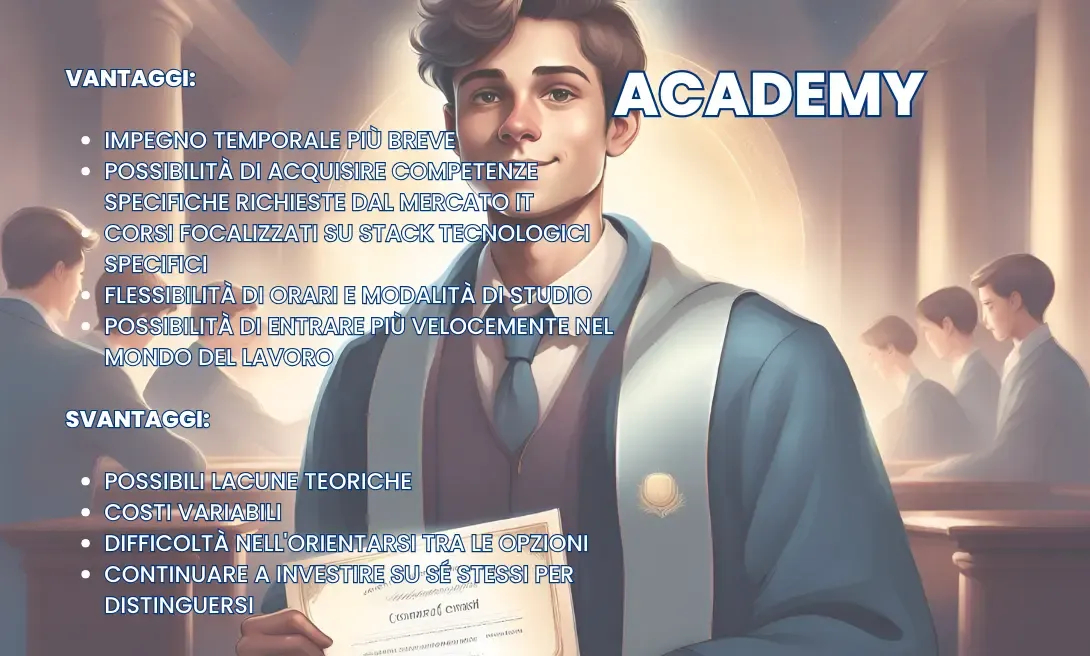
Advantages and disadvantages of the Academy
Soft skills: the secret weapon of junior profiles
A very important aspect when we present ourselves to a company is that ofexperience: not understood only as work experience but also experience gained by collaborating on others' projects or creating a personal portfolio, whether this is done during an academy or a university course matters relatively.
In daily work, the difference is made by skills. And for junior figures, soft skills often make the real difference. For example, soft skills are critical for communicating and collaborating with others, navigating business processes and roles, and time management skills.
While technical skills, if sufficient, enable one to do one's job properly and functionally. Both of these types of skills will need to be improved upon entering the workforce through continuing education and professional experience. But at the selection stage, for us junior figures, it is often soft skills that make the difference.
Finally, let's not forget that in the selection phase, studies carry a lot of weight, especially for junior profiles, and once significant work experience is gained, training may take a back seat.
Bottom line: degree or Academy?
There is no one path regardless that is better than another. They are two very different experiences. Detractors of universities accuse them of not keeping up with the times and providing few practical skills immediately expendable in the world of work, while detractors of academies argue that they give too much information without the time to assimilate it, deluding people into thinking they can become seasoned professionals in a handful of months.
Finally, these two worlds are absolutely compatible. Personally, having experience with both worlds, what I recommend is to be as aware as possible of what the path one chooses consists of and what will await one afterwards. It is important to inform yourself thoroughly and possibly hear the opinions of those who have already been through the path. It is essential to have in mind your goals and thetime horizon in which you want to achieve them.
Neither a college degree nor a professionalizing academy guarantees a priori a job in software development. It will always be necessary to keep learning, however, no matter what channel you use to do it.