![[LOGO]-Ulixe_Nova-positive](https://www.ulixenova.com/wp-content/uploads/2025/01/LOGO-Ulixe_Nova-positivo.png#25)


10/07/2024
Angular or React, that's the dilemma--which one to choose for your next IT project
20/01/2023
Angular or React for your Front-End project. In this article we explore the main differences between the two JavaScript technologies for Front-End development.

When you decide to go down the road of Front-End Development, in order to continue and eventually enter the workforce, we will need to study a frameworkand/or a library, and the most in-demand technologies currently are Angular and React.
Before going any further, it should be specified that both are excellent solutions, and the choice should be made according to the type of project you are going to work on.
Index
The main differences between Frameworks and Libraries
For those who obviously do not already know the differences, the question arises, what distinguishes a framework from a library? Here is a brief distinction:
A frameworkis a framework that aids the programmer in developing an application according to a certain approach.
Otherwise, for librarymeans a set of specific functions that the developer will call to solve a given task.
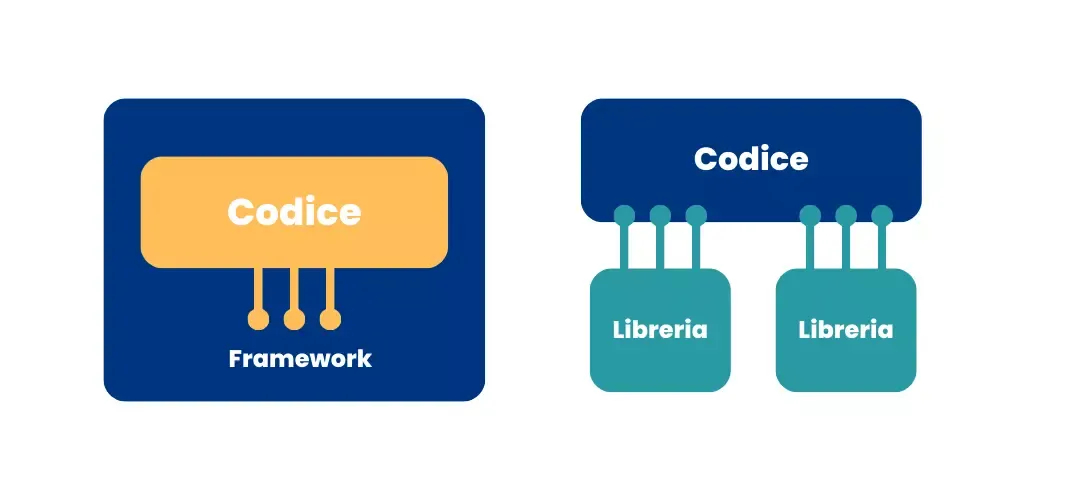
Difference between framework and library
Angular: the JS framework signed by Google
Angular is an open-source framework based on TypeScript and developed by a team of Googlewith which you can create applications for both web and mobile.
One of the things that differentiates Angular from other frameworks is bidirectional data-binding . With this special feature, we have real-time synchronization of data; for example, if we change the value of an input, we will automatically have the property added in the component class updated.
When we decide to learn Angular or use it for our projects, we need to know that everything happens under the same "hood," which gives us a 'ready-to-use' ecosystem!
In fact, bidirectional data-binding, HTTP call handling, dependency injection, routing, form handling, etc.,make development much more accessible, although initially the learning curve of this framework is much higher than other solutions.
In addition, Angular is based on the Model-View-Controller (MVC) architectural pattern, which divides our application into three logical components each with a different purpose: Model, View and Controller.
In this way, all the data in our app will be managed through the Model, while the View will monitor and manage precisely the view of the data. Finally, theController acts as a bridge between model and view.
Usually this type of architecture is used in projects with great scalability, such as in the case of developing management of various kinds (banking, healt-care, etc.).
Why to choose or not to choose Angular over React?
Okay... I think for people who have never dealt with Angular, or at any rate with a framework, all this 'meat in the fire' more than gluttony may instill a bit of fear, but actually once you learn the concepts behind it you will already have the first satisfactions, whether for study or work.
In summary, here are the advantages and disadvantages to consider when choosing to develop with Angular:
Benefits
- Component structure;
- Two-way data-binding;
- Testing;
- Typescript;
- Angular Cli;
- Excellent form management.
Disadvantages
- Learning curve is high, as in order to use this framework you must first learn TypeScript.;
- Hierarchical architecture;
- Two-way binding can sometimes affect performance.
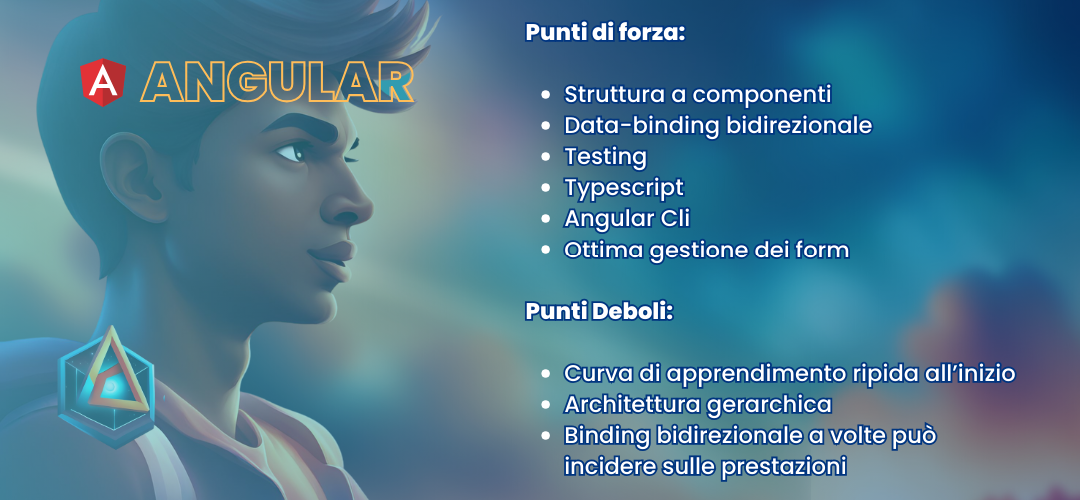
Angular: pros and cons
Let's talk about React
Unlike Angular, React is not a framework but rather a JavaScript-based library. The library was developed by Meta (the former Facebook) in 2013 for creating User Interfaces (UIs), web-apps and mobile apps.
The concept behind it is common to other frameworks and/or libraries, namely having the ability to design and reuse components within our applications.
React uses a special syntax for creating applications called JSX, an extension of JavaScript syntax that allows the combination of JS logic and user interface logic. This way the use of methods such as document.getElementById, querySelector are no longer necessary for DOM manipulation.
With React you have more freedom in a sense, because being a library the developer does not necessarily have to follow "development patterns"; although in fact it would be appropriate to do so.
Thus, React turns out to be very extensible, since it is the developer who chooses the tools to work with, such as design and layout libraries.
For those new to JavaScript, certainly React is simpler and much less verbose than Angular, because if you have a good base of JavaScript, React can be learned fairly quickly.
Advantages and disadvantages of React versus Angular
Benefits
- Component structure;
- easy to learn;
- better performance;
- very extensible.
Disadvantages
- React handles only the user interface, you have to use other tools for the other parts of development;
- sometimes JSX is confusing, since we will often find JS in our HTML template;
- form management is more complex.

Ad maiora semper...
Well, now that we have a general overview of what a framework and library is and the main distinctions between Angular and React we just have to choose what to focus on and start this fantastic adventure into the world of Front-End development.